The Corporate Carbon Overhang Project
A research initiative quantifying how future carbon emissions translate into firm-level financial exposure.
About the Project
Why Carbon Costs Matter for Valuation
Carbon pricing—through emissions trading systems, carbon taxes, and fossil fuel taxes—has become a central policy tool in the global response to climate change. By attaching a financial cost to greenhouse gas emissions, these mechanisms turn environmental externalities into direct cash-flow obligations for firms.
The scale of these liabilities depends on how much a firm emits, where it operates, and how carbon prices evolve. As more jurisdictions adopt or strengthen carbon-pricing regimes, climate policy exposure is becoming a material driver of long-term value. Yet, corporate liabilities tied to future carbon costs remain largely underexplored in capital markets research, which has focused on historical emissions rather than forward-looking, location-specific forecasts of emissions and carbon prices.
The COH Metric
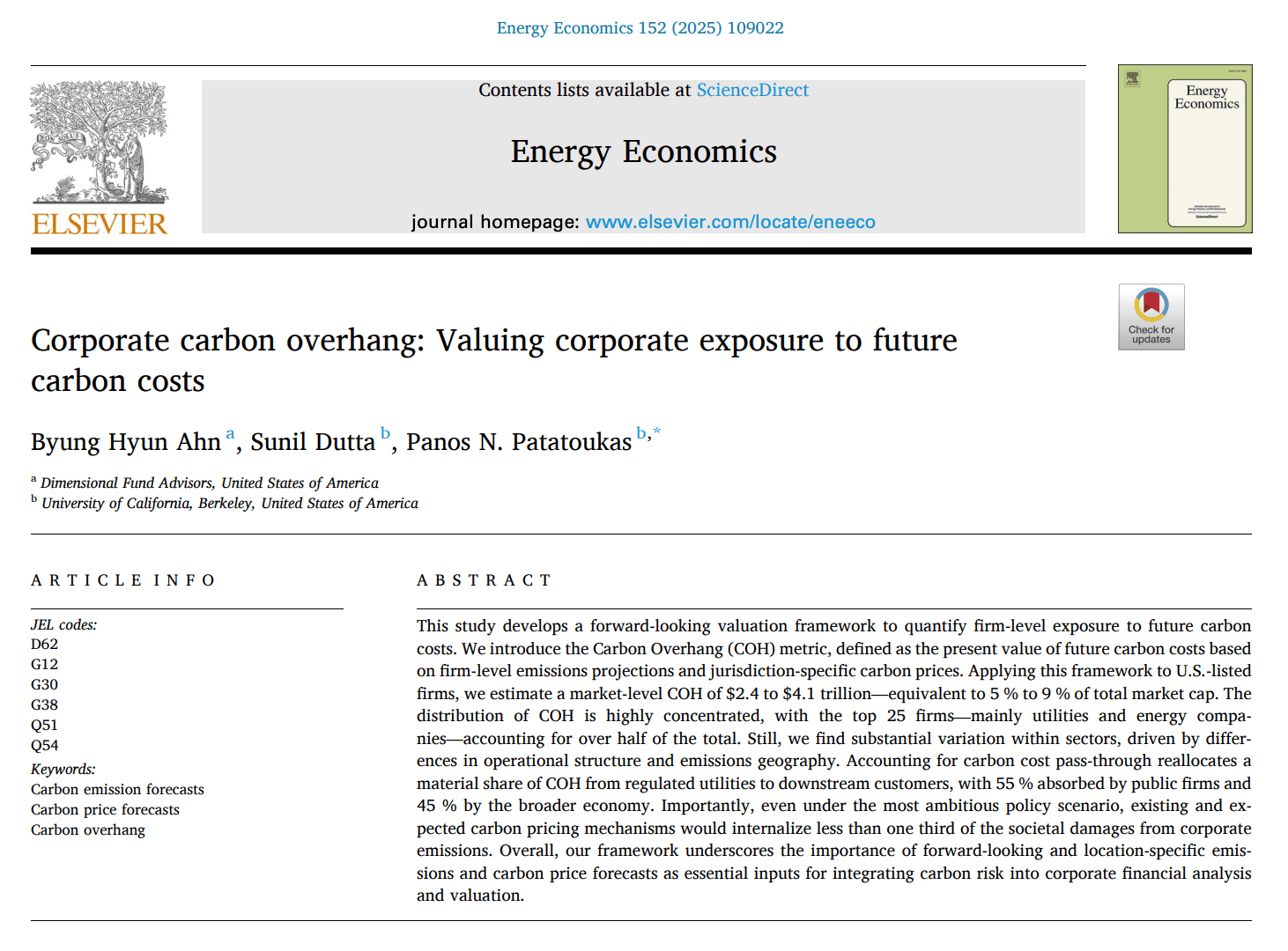
The Corporate Carbon Overhang (COH) is a forward-looking valuation framework that translates future carbon emissions into firm-level carbon liability. COH measures the present value of expected future carbon costs under plausible carbon-price scenarios by combining firm-level emissions projections, jurisdiction-specific carbon price forecasts, and firm-specific discount rates. Conceptually, COH represents the internalized portion of future societal carbon damages reflected in corporate financial exposure under current and projected regulatory carbon pricing.
Key Findings
Applying the COH framework to U.S.-listed firms yields several key insights:
- Aggregate Exposure: The baseline total corporate carbon overhang is estimated at $3.1–$3.6 trillion, equivalent to 6.5%–7.5% of total market capitalization.
- Concentration: The distribution of COH is highly skewed—the top 25 firms, primarily in Utilities and Energy, account for more than half of the aggregate carbon liability.
- Within-Sector Variation: Despite this concentration, there is substantial variation within sectors, driven by differences in operational structure and the geographic distribution of emissions.
- Pass-Through Effects: Accounting for carbon-cost pass-through reallocates exposure from regulated utilities to downstream firms, with 55% absorbed by public companies and 45% by the broader economy.
- Internalization Gap: Even under the most ambitious policy scenario, current and anticipated carbon pricing mechanisms would internalize less than one-third of total societal damages from corporate emissions.
- Implication: These results underscore the importance of forward-looking, location-specific emissions and carbon price forecasts as essential inputs for integrating carbon risk into corporate financial analysis and valuation.
Research Team
 Byung Hyun Ahn
Senior Researcher at Dimensional Fund Advisors
Byung Hyun Ahn is a Senior Researcher at Dimensional Fund Advisors. His work focuses on quantitative research for both academic and applied publications, including the design and simulation of new investment strategies. He also collaborates with clients and prospects on investment processes and solutions. He earned his Ph.D. in Accounting from the University of California, Berkeley.
 Sunil Dutta
Berkeley Haas Professor | William D. Crawford Chair in Taxation and Accounting
Sunil Dutta is the William D. Crawford Chair in Taxation and Accounting at UC Berkeley Haas. He earned degrees from IIT, University of Minnesota, and has published extensively on accounting information, valuation, and performance evaluation. He serves on editorial boards of The Accounting Review and Review of Accounting Studies.
 Panos N. Patatoukas
Berkeley Haas Professor | L.H. Penney Chair in Accounting
Panos N. Patatoukas is the L.H. Penney Chair in Accounting at Berkeley Haas. His research bridges accounting, finance, law, and economics, with focus on valuation, sustainability reporting, and macroforecasting. A recipient of UC Berkeley’s Distinguished Teaching Award and two-time Notable Contributions to Accounting Literature Award winner, he co-directs the Sustainable & Impact Finance Initiative.